Is Schumacher a Good Battery Charger?
Yes, Schumacher is a good battery charger for most home garages. The brand has built automotive power products since 1947, and its current line covers smart multi-stage charging, 6V and 12V support, desulfation and engine-start models.
On this page (8 sections)
- What makes Schumacher chargers worth considering?
- Which Schumacher charger fits your garage?
- How does Schumacher charging compare with Battery Tender?
- Are Schumacher chargers safe to leave connected?
- Which battery types do Schumacher chargers support?
- Is a 6A or 15A Schumacher charger the better buy?
- Where does Schumacher fall short?
- So, is Schumacher a good battery charger for you?
Yes, Schumacher is a good battery charger for most home garages. The brand has built automotive power products since 1947, and its current line covers smart multi-stage charging, 6V and 12V support, desulfation and engine-start models.
The answer changes a little by model, so the sections below break down where the brand earns its keep and where a different charger suits you better.
Schumacher's strength is breadth. You can buy a simple 6A maintainer or a 15A charger with a boost mode, and both run microprocessor control with automatic voltage detection.
That range means most drivers can find one unit that fits their garage without hunting across brands.
What makes Schumacher chargers worth considering?
Microprocessor control and multi-stage charging are the core reasons. Schumacher's chargers adjust the charge rate as the battery fills, which is gentler on plates than a fixed high-amp charge.
The SC1280, for example, detects whether it's hooked to a 6V or 12V battery and then runs a multi-stage algorithm. Its 15A bulk charge moves quickly, and a 3A maintain mode takes over once the battery is full.
That two-part approach is what separates a real charger from a basic trickle unit.
The SC1281 goes further. It combines 6A charging and maintaining with a 100A engine start, a 12A to 30A boost, a battery and alternator tester, and a desulfation mode.
That's five jobs in one box for a garage that wants one tool to do everything.
Schumacher also lists UL 1236, FCC and DOE compliance on these units. For a charger that stays plugged in overnight, that matters more than a flashy feature list.
See how the brand stacks up in our Schumacher vs Battery Tender comparison.
Which Schumacher charger fits your garage?
The SC1280 15A is the best all-round pick for most people. It charges faster than the 6A units and still has a maintain mode for long-term storage.
The SC1281 is the pick when you want engine-start help, and the SC1361 is the 6A option with a 50A start.
Who should pick the SC1280 15A?
Pick the SC1280 if you want faster charging for cars, trucks, SUVs and boats without paying for a jump-start feature. Its 15A rate shortens charge time on larger batteries compared with a 6A unit.
It handles standard, AGM, gel and deep-cycle batteries. The 3A maintain mode keeps a stored vehicle topped up, and the 2A setting suits 6V batteries.
Our Schumacher SC1280 review goes deeper on its charging stages.
Skip it if you need to start a dead engine without jumper cables. That's the SC1281's job.
Who should pick the SC1281 6A?
Pick the SC1281 if you want one unit that charges, maintains, tests and jump-starts. The 100A engine start is the feature that sets it apart from the SC1280.
Its 2A to 6A smart trickle charge lets you leave it connected for storage. The desulfation mode and alternator test help when a battery has been sitting or you suspect a charging problem.
It also supports 12V lithium (LiFePO4) batteries.
Skip it if your battery is healthy and you only need routine top-ups. The extra engine-start hardware is more than you'll use.
Who should pick the SC1361 6A?
Pick the SC1361 if you want a 6A charger with a 50A engine start for a car, ATV or motorcycle battery. It's the smallest engine-start option in this group.
It runs reverse hook-up protection, so it won't operate if the clamps are reversed. The 10A boost and 50A start cover light-duty starting, and the 2A to 6A charge mode handles regular charging.
It's limited to 12V batteries, so a 6V application needs a different model.
How does Schumacher charging compare with Battery Tender?
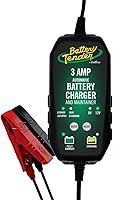
Schumacher leans toward faster charging and engine starts, while Battery Tender leans toward small, simple maintainers. Neither is better across the board; the right pick depends on how you use the charger.
If your main job is keeping a stored motorcycle or classic car battery topped up, a compact maintainer is easier to live with. If you revive dead batteries, charge a truck battery quickly or want a jump-start backup, Schumacher's higher-amp and multi-function models make more sense.
Our Schumacher vs Battery Tender comparison walks through the model-to-model differences.
The honest split is this: Schumacher's line goes up to 15A and 100A engine starts. Battery Tender's strength is long-term float maintenance.
Buy for the job you actually do, not the brand name.
Are Schumacher chargers safe to leave connected?
Yes, the maintainer models are designed for it. The SC1281 and SC1361 both use a smart trickle charge that automatically adjusts voltage so the battery doesn't overcharge.
The SC1280's 3A maintain mode does the same job.
Safety features go beyond the trickle charge. Schumacher lists reverse polarity protection and automatic shutoff on these units, and the SC1361 adds spark-proof clamps.
The SC1280 and SC1281 both detect 6V or 12V automatically, which removes a common setup mistake.
That said, leaving a charger connected for months still deserves a quick check. Look at the clamps and cables now and then, keep the unit out of standing water, and follow the manual's placement advice.
The steps in how to use a Schumacher battery charger cover the connection order that keeps you safe.
Which battery types do Schumacher chargers support?
Most Schumacher models cover standard, AGM, gel and deep-cycle batteries. The SC1280 and SC1281 list all four, and the SC1281 adds 12V lithium (LiFePO4) support.
The SC1361 covers standard and AGM 12V batteries.
The SC1280 and SC1281 handle both 6V and 12V batteries. The SC1361 is 12V only, so it suits cars, trucks, ATVs and most motorcycle batteries but not a 6V classic.
Lithium support matters if you run a LiFePO4 battery in a boat or camper. Not every Schumacher model lists it, so match the charger to the battery chemistry you actually own.
Charging a lithium battery with a lead-acid-only charger is a risk worth avoiding.
Is a 6A or 15A Schumacher charger the better buy?
Buy 15A if you charge large or deeply drained batteries often. Buy 6A if you mainly maintain healthy batteries or want an engine-start model at a lower amp rating.
The 15A SC1280 puts more current into the battery per hour, which shortens charge time on a big truck or marine battery. That's the practical reason to step up.
Our roundup of the best 10 amp battery chargers shows where mid-amp units sit in the wider market.
The 6A units are the better fit when charging speed isn't the bottleneck. The SC1281 pairs its 6A rate with a 100A engine start, and the SC1361 pairs its 6A rate with a 50A start.
For a battery that's usually healthy and only needs topping up, 6A is plenty and easier on the battery over long sessions.
A 6A charger on a dead 100Ah battery will take noticeably longer than 15A. If you regularly deal with flat batteries, the higher amp rating saves you a day.
Where does Schumacher fall short?
Schumacher's weak spot is simplicity and size. Its multi-function units carry more features than a basic maintainer, and the bigger models take up more bench space and weigh more.
The SC1281 weighs 12.7 lb and measures 10.25 x 10 x 7 inches. That's fine as a garage fixture, but it's not the unit you toss in a saddlebag.
A compact maintainer is easier to carry to a stored motorcycle or boat.
The feature count is also a trade-off. Engine start, boost, testing and desulfation are useful, but each one adds controls and steps to learn.
If you want plug-and-forget, a single-purpose maintainer asks less of you.
None of this makes Schumacher a bad choice. It means you should pick the model that matches your job rather than buying the biggest one.
For a garage that wants one capable tool, the extras pay off. For a battery that only needs a slow top-up, they don't.
So, is Schumacher a good battery charger for you?
For most drivers, yes: the SC1280 15A is the pick when you want fast, smart charging, and the SC1281 is the pick when you want engine-start help in the same box. The SC1361 covers light-duty starting on a 12V budget.
Choose Schumacher if you want microprocessor control, 6V and 12V auto detection and models that charge, maintain and start. Choose a compact dedicated maintainer if your only job is keeping a stored battery topped up.
The brand's 1947 heritage and its UL-listed units back the choice either way.
Before you buy, match the charger to your battery chemistry and voltage. A 12V-only model won't serve a 6V classic, and a lead-acid charger isn't the right tool for a lithium pack unless the model lists support.
Once the match is right, Schumacher's smart charging does the rest.
Frequently asked questions
What is the difference between the SC1280 and the SC1281?
The SC1280 is a 15A charger and maintainer with a 3A trickle mode. The SC1281 adds a 100A engine start and a battery and alternator tester on top of its 6A charging.
Pick the SC1280 for faster everyday charging and the SC1281 for jump-start help.
Do Schumacher chargers work on AGM and lithium batteries?
The SC1280 and SC1281 support standard, AGM, gel and deep-cycle batteries, and Schumacher says the SC1281 also handles 12V lithium (LiFePO4). The SC1361 covers standard and AGM 12V batteries.
Match the charger to your battery type before connecting.
Can I leave a Schumacher charger connected for storage?
Yes, on the maintainer models. The SC1281 and SC1361 both use a smart trickle charge that holds voltage over time so you can leave them connected.
The SC1280 has a 3A maintain mode for the same purpose.
Check the clamps and cables now and then while it stays hooked up.
How long does a Schumacher charger take to charge a battery?
Charge time depends on the battery's size and how depleted it is. Schumacher gives a 10-hour charge time for the SC1280, SC1281 and SC1361.
A deeply drained or large battery will take longer than a lightly used one, so plan around a full day for a dead battery.
Is Schumacher better than Battery Tender?
They suit different jobs. Schumacher leans toward faster charging and engine-start models like the SC1281.
Battery Tender focuses on small, simple maintainers.
If you mostly keep stored batteries topped up, a compact maintainer is enough; if you revive dead batteries and want jump-start help, Schumacher gives you more.