Are NOCO Battery Chargers Any Good?
Yes, NOCO battery chargers are good for most people. The GENIUS5 and GENIUS10 handle 6V and 12V lead-acid and lithium batteries, adjust for temperature, and can recover deeply discharged batteries. The main question is which amperage fits your battery.
On this page (9 sections)
- What makes a NOCO charger good?
- How does NOCO handle temperature and overcharging?
- Is the NOCO GENIUS5 enough for most batteries?
- When should you step up to the NOCO GENIUS10?
- Which NOCO amperage fits your battery?
- How do NOCO chargers compare with CTEK?
- Do NOCO chargers work for boats, RVs and long-term storage?
- How do you set up and use a NOCO charger?
- Are NOCO battery chargers any good? The verdict
Yes, NOCO battery chargers are good for most buyers. The GENIUS5 and GENIUS10 handle 6V and 12V lead-acid and lithium batteries, adjust their charge to the ambient temperature, and can bring back deeply discharged batteries.
The real decision is amperage: 5 amps for smaller batteries and tighter spaces, 10 amps when you want speed and capacity.
That answer holds up when you look at what the chargers actually do. The two models most people weigh are close cousins that differ mainly in output.
This guide breaks down where they earn their reputation and where a different brand makes more sense.
What makes a NOCO charger good?
The GENIUS chargers cover more battery types and conditions than a basic trickle charger. Both models work on 6-volt and 12-volt lead-acid batteries (AGM, gel, SLA, VRLA, flooded, maintenance-free and deep-cycle) and on lithium-ion LiFePO4 packs.
The feature that separates NOCO from a plain maintainer is recovery. The GENIUS line charges batteries from as low as 1 volt, and Force Mode lets you manually charge a completely dead battery down to zero volts.
A battery that sat all winter or got drained by a dome light is exactly the case these chargers are built for.
Precision pulse charging also detects and reverses sulfation and acid stratification. That's the slow buildup that leaves an old battery weak even after a full charge.
NOCO says the process restores battery health and extends lifespan, which is why the same unit works as a charger, maintainer, trickle charger and desulfator.
How does NOCO handle temperature and overcharging?
An integrated thermal sensor adjusts the charge based on ambient temperature. In hot weather the charger trims the voltage so it doesn't overcharge; in cold weather it raises it so the battery actually fills.
A charger without that sensor can undercharge a cold battery or cook a hot one.
The maintainer side matters just as much. NOCO says its smart chargers constantly monitor the battery and can stay connected indefinitely without overcharging.
That's the difference between a charger you babysit and one you leave on a boat or stored car for months.
Both models are built for that set-and-forget role. The charger holds the battery at a safe float level and only adds current when the voltage drops.
For a vehicle that sits, that's the whole job.
Is the NOCO GENIUS5 enough for most batteries?
The GENIUS5 is the right pick for most people. It delivers 5 amps and covers batteries up to 120 amp-hours, which takes in motorcycle, ATV, lawn mower, car and many marine batteries.
NOCO rates its charge time at about 8 hours.
It's also compact: 3.43 by 4.61 by 7.95 inches and 1.6 pounds. That size suits a shelf, a garage wall or a spot under a seat, and the box includes a mounting bracket with a Velcro strap plus an 80-inch DC cable with clamps and integrated eyelet terminals.
NOCO backs it with a 3-year warranty and designs it in the USA.
The GENIUS5 replaced the older G3500 and is 34% smaller while delivering over 65% more power. If your battery bank is small or you want one charger that moves between vehicles, the 5-amp unit does the job without the bulk.
When should you step up to the NOCO GENIUS10?
Step up to the GENIUS10 when you charge large batteries or want less waiting. The 10-amp version covers batteries up to 230 amp-hours and charges faster than the GENIUS5 on the same battery.
NOCO rates its charge time at about 10 hours.
It carries the same feature set: temperature compensation, Force Mode down to zero volts, pulse charging to reverse sulfation, and indefinite maintainer mode. It's also 17% smaller than its predecessor, the G7200, while delivering over 115% more power.
The trade-off is size and weight: 4.48 by 4.41 by 9.1 inches and 4 pounds.
The GENIUS10 makes sense for a truck, an SUV, a large RV house battery or a deep-cycle marine bank. It's more charger than a motorcycle battery needs, and its larger body takes more room on a wall or shelf.
Our NOCO GENIUS10 review covers how it compares when you charge bigger banks.
Which NOCO amperage fits your battery?
Match the charger to your battery's amp-hour rating, not to the biggest number. NOCO rates the GENIUS5 for batteries up to 120 amp-hours and the GENIUS10 up to 230 amp-hours.
Below 120 amp-hours, the 5-amp unit charges fully without overkill.
Above that, the 10-amp model gets the job done in reasonable time.
Your space matters too. The GENIUS5's smaller footprint fits tighter spots, while the GENIUS10 needs more room and weighs more than twice as much.
If the charger lives on a garage wall, that's a minor factor; if it rides in a toolbox or under a seat, it isn't.
Battery type matters less between these two, because both handle lead-acid and LiFePO4. The deciding questions are capacity and how fast you want the battery back.
How do NOCO chargers compare with CTEK?
NOCO wins on amperage choice and dead-battery recovery; CTEK wins on diagnostics. The CTEK 4.3 Test & Charge delivers 4.3 amps and adds test programs that establish the condition of the battery and the vehicle's charging system.
NOCO's GENIUS models don't include that alternator testing.
The CTEK runs its own 8-step charging process and uses float/pulse maintenance for batteries up to 160 amp-hours. It's spark-free and reverse-polarity protected, so a mis-clipped lead won't cause a spark.
NOCO offers the same safety basics but puts its effort into Force Mode and higher amperage options.
If you want to know whether a battery or alternator is failing, the CTEK 4.3 earns its place. If you want faster charging and a charger that revives a zero-volt battery, NOCO is the better fit.
Our CTEK 4.3 Test & Charge review goes deeper on its test modes.
Do NOCO chargers work for boats, RVs and long-term storage?
Yes, and maintenance is where they shine. NOCO's indefinite-connect design means you can wire the eyelet terminals to a battery and leave the charger plugged in through the off-season.
The GENIUS5 and GENIUS10 both keep the battery topped off without overcharging.
That suits boats, campers, trailers, jet skis and classic cars that sit for months. For a boat with two batteries, the NOCO GEN5X2 onboard charger review covers a two-bank model built for that job.
A single-battery owner can use the GENIUS5 the same way with the included eyelet terminals.
If your battery is in a vehicle you drive weekly, a simple maintainer is enough. If it's in a rig that sits for long stretches, the automatic maintenance mode is the reason to choose NOCO over a basic charger.
How do you set up and use a NOCO charger?
Connect the clamps or eyelets to the battery, plug the charger in, then select the battery type and mode. Clamp red to positive and black to negative, and keep the leads clear of moving parts before you power up.
The charger reads the battery voltage and starts its profile automatically. On a dead battery, Force Mode overrides the safety cutoff so the charger can push current into a zero-volt pack.
Leave it running until the charge completes, then switch to maintenance if the battery will sit.
Our guide to how to use a NOCO Genius5 battery charger walks through the button sequence and the indicator light meanings step by step. It's worth reading once before your first charge so you don't skip the battery-type selection.
Are NOCO battery chargers any good? The verdict
For most people, yes: the GENIUS5 is the NOCO charger to buy. It covers the batteries most households and garages actually own, it's small enough to mount anywhere, and it recovers dead batteries that a simple maintainer can't.
The 5 amps are enough up to 120 amp-hours.
Buy the GENIUS10 if your battery bank is large or you want faster charging and don't mind the extra size and weight. Choose the CTEK 4.3 instead if alternator testing matters more than amperage options.
And if you're still weighing brands against each other, our Schumacher vs Battery Tender comparison shows how the other big names stack up.
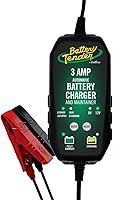
If you only need to keep a healthy battery topped off, a small maintainer like the one in our Battery Tender 3 Amp review covers that job for less. NOCO's edge is when the battery is deeply discharged or you want one unit for charging and maintaining all year.
Frequently asked questions
What is the difference between the NOCO GENIUS5 and GENIUS10?
The GENIUS5 delivers 5 amps and the GENIUS10 delivers 10 amps. The bigger model covers larger batteries up to 230 amp-hours, while the GENIUS5 covers batteries up to 120 amp-hours and fits smaller spaces.
Do NOCO chargers work on lithium batteries?
Yes. Both the GENIUS5 and GENIUS10 are built for 6-volt and 12-volt lead-acid batteries (AGM, gel, flooded and deep-cycle) plus lithium-ion LiFePO4 batteries.
You choose the battery type before charging so the charger applies the right profile.
Can I leave a NOCO charger connected all the time?
Yes. NOCO says its smart chargers monitor the battery and can stay connected indefinitely for maintenance without overcharging.
That makes them a fit for a boat, camper or classic car that sits for months at a time.
How long does a NOCO charger take to charge a battery?
Charge time depends on battery size and depth of discharge. NOCO rates the GENIUS5 at about 8 hours and the GENIUS10 at about 10 hours, so a deeply drained large battery takes longer than a lightly used one.