8 Best Onboard Boat Battery Chargers (October 2026)
The best onboard marine battery chargers include the NOCO GEN5X2 Onboard Marine for two-bank versatility, the NOCO GENPRO10X2 Onboard Marine for higher two-bank output, and the NOCO GENPRO10X1 Onboard Marine for one battery.
On this page (5 sections)
The best onboard boat battery charger for most two-battery setups is the NOCO GEN5X2, with independent 5A banks and modes for lead-acid and lithium batteries. For more current per bank, consider the GENPRO10X2; for four batteries, the GENPRO10X4 offers four independent banks.
Choose by battery count, chemistry and current per bank. A charger’s total output can be divided among its banks, so compare the per-bank figure with your charging needs.
If you’re still deciding between an onboard unit and a portable charger, our NOCO Genius10 vs GENPRO10X1 comparison explains the difference between those formats. For chemistry-specific guidance, see 12V lithium battery chargers.
Our picks at a glance
-
1

-
2

-
3
- 4
 Check it
NOCO GENPRO10X4 Onboard Marine
Best for four batteries - 5
 Check it
ProMariner ProSport HD 8A 2-Bank
Best for smaller two-bank systems - 6
 Best for a single lead-acid batteryCheck it
- 7
 Best for two LiFePO4 batteriesCheck it
- 8
 Check it
ECO-Worthy 2-Bank Marine Charger
Best for mixed battery modes
Which onboard boat battery chargers fit different setups?
The best fit depends on how many batteries you need to charge and how much output each bank provides. These picks include single-bank, two-bank and four-bank options, with different chemistry support.
NOCO GEN5X2 Onboard Marine: Best for two-bank versatility
- Two independent 5A banks
- 12V, AGM, Lithium and Repair modes per bank
- IP68 sealed housing
- Temperature sensor adjusts charging
Two independently controlled banks and selectable modes make this a flexible fit for a boat with two 12V batteries. Its IP68 rating and temperature sensor address common onboard conditions.
Pros
- Independent charging modes per bank
- Supports lead-acid and lithium-ion
- IP68 waterproof rating
Cons
- 5A per bank may not fit every charging-speed need
- Designed for 12V batteries
The GEN5X2 is the lead pick for a typical two-battery arrangement because its two 5A banks work independently. You can select a 12V, AGM, Lithium or Repair mode for each bank, which helps when the batteries differ in chemistry or condition.
NOCO gives this model an IP68 rating and includes a thermal sensor that adjusts charging for ambient temperature. It can start charging from 1V, with Force Mode for manually starting at zero volts.
Its 10A total output is shared evenly between two banks. If your batteries call for more than 5A each, the GENPRO10X2 provides 10A per bank.
Choose the GEN5X2 when you want separate settings for two 12V batteries in a sealed onboard unit. Its product details specify compatibility with lead-acid and lithium-ion batteries, including LiFePO4.
NOCO GENPRO10X2 Onboard Marine: Best for higher two-bank output
- Two independent 10A banks
- 12V, AGM, Lithium and Repair modes per bank
- IP68 sealed housing
- Temperature sensor adjusts charging
This two-bank model supplies 10A to each battery, twice the per-bank output of the GEN5X2. It also offers separate charging modes for each bank.
Pros
- 10A per bank
- Independent modes for each battery
- IP68 waterproof rating
Cons
- More output may be unnecessary for a modest setup
- Designed for 12V batteries
The GENPRO10X2 is the stronger two-bank choice when 10A per battery suits your setup. Each bank can be set independently for 12V, AGM, Lithium or Repair mode.
Like the GEN5X2, it has an IP68 rating and a temperature sensor. NOCO also specifies Force Mode for starting a charge on a battery down to zero volts.
The difference to weigh is output, not bank count: both models charge two batteries, but the GENPRO10X2 supplies 20A total. Confirm your battery manufacturer’s recommended charging current before choosing the higher-output model.
Choose it for two batteries that can use 10A per bank and need independent modes. If 5A per bank is enough, the GEN5X2 covers the same bank count with less output.
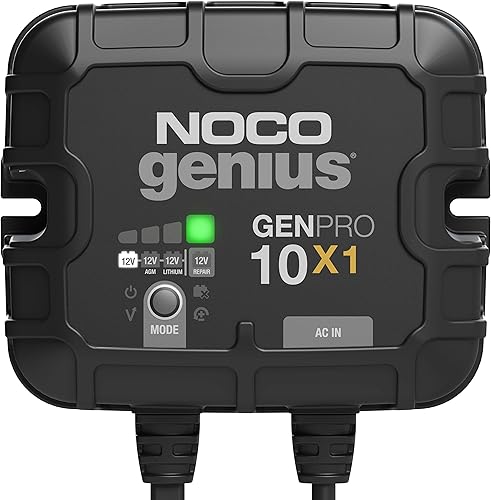
NOCO GENPRO10X1 Onboard Marine: Best for one battery
- One 10A bank
- 12V, AGM, Lithium and Repair modes
- IP68 sealed housing
- Temperature sensor adjusts charging
A single 10A bank suits a boat with one battery to charge. It shares the GENPRO family’s selectable modes, sealed housing and temperature adjustment.
Pros
- 10A output for one battery
- Supports lead-acid and lithium-ion
- IP68 waterproof rating
Cons
- Only one bank
- Designed for 12V batteries
The GENPRO10X1 is a single-bank 10A charger for a boat with one battery to maintain or charge. Its selectable 12V, AGM, Lithium and Repair modes cover several battery types and conditions.
It shares the other GENPRO models’ IP68 rating and temperature adjustment feature. NOCO also specifies Force Mode for starting a charge on a battery down to zero volts.
This model makes more sense than a two-bank charger when you have one battery in the charging setup. If you need separate charging for two batteries, the GEN5X2 or GENPRO10X2 offers two banks.
Choose the GENPRO10X1 when a single 12V battery and 10A output match your requirements. Check the battery’s chemistry and charging instructions before selecting a mode.
NOCO GENPRO10X4 Onboard Marine: Best for four batteries
- Four independent 10A banks
- 12V, AGM, Lithium and Repair modes per bank
- IP68 sealed housing
- Temperature sensor adjusts charging
Four independent banks let this charger serve a multi-battery boat. Each bank has 10A available and its own selectable charging modes.
Pros
- Four independent banks
- 10A per bank
- IP68 waterproof rating
Cons
- Four banks may be more than a small boat needs
- Designed for 12V batteries
The GENPRO10X4 serves a boat with four batteries to charge independently. Each bank provides 10A, for 40A total, and has its own selectable charging mode.
Its IP68 rating, temperature sensor and Force Mode mirror features found across the GENPRO models. The four-bank layout is the key reason to choose it over the single- and two-bank picks.
Count the batteries you intend to connect and confirm that each one is a 12V battery within the stated chemistry compatibility. Four banks add flexibility, but a smaller system may not need them.
Choose this model when four independent 10A banks fit the boat’s battery arrangement. For two batteries, the GENPRO10X2 offers the same 10A per-bank output with fewer banks.
ProMariner ProSport HD 8A 2-Bank: Best for smaller two-bank systems
- 8A across two banks
- Distributed-on-demand charging
- Selectable LiFePO4, flooded, AGM and GEL profiles
- LED status and fault indicators
This 8A charger is aimed at compact two-bank marine systems. Distributed-on-demand charging allocates current between batteries, and LEDs show status or faults.
Pros
- Supports several lead-acid types and LiFePO4
- Distributed-on-demand charging
- LED status indicators
Cons
- 8A is shared across the banks
- Confirm system voltage needs before buying
The ProSport HD is aimed at smaller two-bank marine systems and provides 8A across its banks. Its distributed-on-demand feature allocates charging current between batteries rather than fixing the same output to each bank.
It offers selectable profiles for LiFePO4, flooded, AGM and GEL batteries. LED indicators show charge status and fault conditions, while its automatic five-stage charging supports 12V and 24V systems.
Because its 8A is shared, compare that total with the needs of both batteries. The charger’s stated system support includes 12V and 24V, so make sure the setup you plan to charge is compatible.
Choose it if a compact two-bank charger with visible status indicators fits your needs. For a higher-output two-bank option, compare the GEN5X2 and GENPRO10X2.
Marinco ChargePro Onboard: Best for a single lead-acid battery
- 6A, one-bank 12V charger
- Supports flooded, AGM and Gel batteries
- Microprocessor controlled
- 120/230V input
The 6A, one-bank ChargePro fits a 12V setup using flooded, AGM or Gel batteries. Marinco describes its charging control as microprocessor controlled.
Pros
- Simple one-bank setup
- 120/230V input
- Supports flooded, AGM and Gel
Cons
- Does not list lithium compatibility
- 6A output
The Marinco ChargePro is a one-bank 6A charger for 12V flooded, AGM or Gel batteries. Its microprocessor-controlled charging and 120/230V input are the main points to compare with other single-bank options.
Marinco describes its Sense-Send feature as sensing each battery’s power needs and sending the correct charge. The model information lists one port and compatibility with lead-acid battery types, but does not list lithium support.
Choose it for a single compatible battery when 6A output is enough. If you need a lithium mode or a second bank, consider one of the other picks instead.
LiTime 2-Bank Lithium Charger: Best for two LiFePO4 batteries
- Two 10A banks
- 14.6V output
- IP65 waterproof rating
- Supports LiFePO4, lithium and lead-acid
Two 10A banks and 14.6V output make this a candidate for a pair of LiFePO4 batteries. It is rated IP65 and also lists support for lead-acid batteries.
Pros
- 10A for each of two batteries
- 14.6V output
- IP65 waterproof rating
Cons
- Check voltage and charging requirements for your battery
- Not rated IP68
The LiTime charger suits two LiFePO4 batteries when 10A per bank and 14.6V output match their charging requirements. It has two banks and an IP65 waterproof rating.
LiTime also lists compatibility with lithium and lead-acid batteries, automatic CC, CV and Float/Cut off transitions, and protection features for conditions such as reverse polarity and over-current. The stated warranty is 2 years.
Check your battery maker’s recommended charging voltage and chemistry before connecting it. The 14.6V output is a key detail to verify for your specific batteries.
Choose it when two-bank LiFePO4 charging is the priority and its output matches your setup. For an IP68-rated two-bank alternative with separate chemistry modes, compare the GEN5X2.
ECO-Worthy 2-Bank Marine Charger: Best for mixed battery modes
- Two independent 5A banks
- SLA/AGM, Lithium and Calcium modes
- IP68 sealed housing
- 12V batteries
This two-bank charger offers separate modes for SLA/AGM, Lithium and Calcium batteries. Its 10A total output is split into 5A per bank.
Pros
- Modes for several battery types
- IP68 waterproof rating
- Force Mode for low-voltage batteries
Cons
- 5A per bank
- Confirm compatibility with your exact battery chemistry
The ECO-Worthy is a two-bank, 10A total charger that supplies 5A to each battery. Its modes cover SLA/AGM, Lithium and Calcium, and it has an IP68 rating.
The listed features include Force Mode for low-voltage batteries, automatic repair for lead-acid batteries and indicators for diagnostics. Confirm the exact battery type and charging requirements before choosing a mode.
Its output matches the GEN5X2’s 5A per bank, while the listed modes differ. Choose this model if its three modes fit your battery mix; compare the NOCO if you want a 12V mode as a separate option.
How should you match bank count and amperage?
Match the bank count to the batteries you want charged independently, then compare each bank’s output with the battery maker’s recommended current. A charger’s total amperage alone doesn’t tell you how much current reaches each battery.
The GEN5X2 supplies 5A to each of two banks, while the GENPRO10X2 supplies 10A to each of two. The GENPRO10X4 provides four 10A banks, and the GENPRO10X1 uses its 10A output on one battery.
ProMariner’s 8A is distributed on demand across two banks. That can suit a smaller system, but it is not the same as having 8A available separately to each battery.
If your boat’s setup includes several batteries, our guide to chargers for multiple batteries explains how to compare bank count and shared output.
Which battery chemistry should the charger support?
Choose a charger with a mode or profile that matches each battery’s chemistry. Chemistry support varies across this group, so check every battery connected to the charger before installation.
The NOCO models offer selectable 12V, AGM, Lithium and Repair modes. ProMariner lists LiFePO4, flooded, AGM and GEL profiles, while ECO-Worthy lists SLA/AGM, Lithium and Calcium modes.
LiTime specifies 14.6V output and support for LiFePO4, lithium and lead-acid batteries. Marinco lists flooded, AGM and Gel compatibility; its product details do not list lithium support.
For more on selecting the right chemistry setting, see our guide to what kind of charger a lithium battery needs. Follow the battery manufacturer’s charging instructions if they differ from a general description.
What should you check before installing an onboard charger?
Check the battery voltage, chemistry, bank count, available mounting space and AC power connection before buying. These details determine whether a charger fits your electrical setup and physical installation.
The NOCO models include 72-inch DC cables with eyelets and a 72-inch AC cable. ProMariner includes AC and DC cables, while LiTime uses M8 battery terminals and a waterproof connector.
The IP ratings also differ: several models are IP68, ProMariner is IP67, and LiTime is IP65. Use the manufacturer’s installation instructions for mounting and electrical connections, and confirm the rating suits the location where the charger will sit.
If you’re weighing a portable option for a smaller vehicle battery, our motorcycle and powersports charger guide covers a different type of setup.
Which onboard boat battery charger should you choose?
Choose the GEN5X2 for two batteries that need independent 5A banks and multiple chemistry modes. Pick the GENPRO10X2 when 10A per bank suits your two-battery system, or the GENPRO10X4 when you need four independent banks.
For one battery, the GENPRO10X1 provides a single 10A bank. Compare ProMariner, Marinco, LiTime and ECO-Worthy by their listed chemistry support, output and protection rating, then confirm the match with your battery maker’s instructions.
For a closer look at one of the leading two-bank options, read our NOCO GEN5X2 onboard marine charger review.[/^H2]
Our top 3 picks at a glance
-
1
-
2
-
3
Frequently asked questions
How many banks should an onboard boat charger have?
Choose one bank for one battery, two banks for two batteries, and four banks when you need to charge four batteries independently. Match the bank count to the batteries you want connected, then check the output available per bank.
A charger’s total amperage may be split across its banks.
Can an onboard marine charger charge lithium batteries?
Some can, but the charger must offer a mode that matches your battery chemistry. NOCO’s GEN5X2, GENPRO10X2, GENPRO10X1 and GENPRO10X4 list selectable lithium modes, while the LiTime model is designed around LiFePO4 charging.
Check your battery maker’s voltage and charging instructions before connecting a charger.
What does IP68 mean for a boat battery charger?
IP68 is the enclosure rating stated for several picks here, including the NOCO models, Marinco and ECO-Worthy. The ProMariner is rated IP67, and LiTime is rated IP65.
An IP rating describes a protection level; follow the installation instructions and keep electrical connections appropriate for marine use.
Is a portable charger the same as an onboard charger?
An onboard charger is installed with the boat’s battery setup and has DC leads for its banks plus an AC power connection. A portable charger is intended to be moved and connected as needed.
For a portable option, compare models in our boat and vehicle battery charger guide, then check whether the charger suits your battery chemistry and capacity.


