How Long Does a Battery Charger Take?
A battery charger usually takes 6 to 12 hours to charge a healthy battery, and the real number is amp-hours divided by charger amps. A 5 amp charger adds about 5 amps per hour, so a 50 Ah battery that is half empty needs roughly 5 hours plus topping-off time.
On this page (8 sections)
- How do you estimate charging time from amps and amp-hours?
- Why a 5 amp charger and a 10 amp charger finish so differently
- How long does a battery charger take on a flat or deeply discharged battery?
- How does battery size change the answer?
- What slows a charge down in real use?
- Does the charger type change how long a charge takes?
- How long should you leave a charger connected?
- The short answer to planning a charge
How long does a battery charger take? Most healthy batteries are full in 6 to 12 hours, and the arithmetic is simple: divide the battery's amp-hours by the charger's amps, then add time for the last stretch.
A 5 amp charger on a 50 Ah battery that needs 25 Ah of charge lands near 5 hours in bulk mode, plus an hour or so to top off.
That single sum explains most of the variation people see. The charger's amperage is the size of the hose, the battery's capacity is the size of the tank, and how empty the battery is decides how much water has to flow.
The rest of this guide walks through the cases where the sum goes wrong, so you can plan a charge instead of guessing at it.
How do you estimate charging time from amps and amp-hours?
Divide the amp-hours you need to replace by the charger's amps, then add 10 to 20 percent for the top-off stage. A 2 amp trickle charger adds 2 amps per hour, so a 40 Ah battery that is half flat needs about 10 hours of bulk charging before the slow finish.
The bulk stage does most of the work and runs at the charger's full rated current. Once the battery reaches around 80 percent, the charger switches to a lower, tapering current to avoid boiling the electrolyte.
That final 20 percent takes a disproportionate share of the clock, which is why a battery that is nearly full still sits on the charger for another hour or two.
Capacity matters more than most people expect. A small motorcycle battery of 10 Ah fills in about 2 hours on a 5 amp charger, while a 100 Ah deep-cycle battery needs a full day.
For a big battery, our guide to the best 10 amp battery charger covers units that cut bulk time roughly in half compared with a 5 amp model.
Why a 5 amp charger and a 10 amp charger finish so differently
Doubling the amps roughly halves the bulk-charge time, but not the whole charge. A 10 amp unit on the same 50 Ah battery reaches the 80 percent mark in about 4 hours, while a 5 amp charger needs about 8.
The taper stage at the end is set by the battery's chemistry, not the charger's size, so the gap narrows as the battery fills.
That is why charger amps are sold in steps. A 4 to 5 amp charger suits most car and motorcycle owners because it is gentle enough for long, unattended sessions.
A 10 amp unit makes more sense for a big diesel truck battery or a bank of batteries that needs a fast turnaround.
The NOCO GENIUS5 is rated at 5 amps for 6-volt and 12-volt lead-acid and lithium-ion batteries. It uses an integrated thermal sensor to adjust the charge with ambient temperature, which matters in a cold garage or a hot shed.
NOCO says it can charge a battery from as low as 1 volt, and a Force Mode lets you manually charge one down to zero volts.
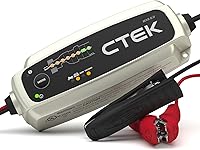
For a smaller, slower approach, the CTEK MXS 5.0 is a 4.3 amp, 8-step unit for 12-volt lead-acid and AGM batteries. CTEK rates its charge time at up to 50 hours on a large battery, which is the slow, gentle end of the scale.
Its float and pulse mode is designed for set-and-forget sessions over months.
How long does a battery charger take on a flat or deeply discharged battery?
Plan on 12 hours or more, because a deeply discharged battery accepts current slowly at first. A battery that reads 10.5 volts or lower has high internal resistance, so the charger cannot push its full rated current into it.
The first hour or two often adds very little usable charge.
Many smart chargers handle this by starting in a low-current recovery phase before moving to bulk charging. The NOCO GENIUS5, for example, charges batteries from as low as 1 volt and offers a Force Mode for ones near zero volts.
The CTEK MXS 5.0's reconditioning function is aimed at underperforming batteries rather than dead ones.
A flat battery left discharged for weeks may never come back. Sulphation builds on the plates and reduces the capacity the charger can restore.
If a charger that used to fill a battery in 8 hours now needs two days and still doesn't reach full, the battery is the likely culprit.
How does battery size change the answer?
Bigger batteries take longer on the same charger, in a straight line. A 5 amp charger needs about 4 hours on a 20 Ah lawn mower battery that is half flat, about 10 hours on a 50 Ah car battery and about 20 hours on a 100 Ah deep-cycle battery.
The best battery charger for diesel truck usually runs at higher amps for exactly this reason. A pair of large truck batteries holds a lot of amp-hours, and a small maintainer would take days to move the needle.
A full recharge after a long sit needs more current.
Lithium batteries behave differently. They accept charge at a steadier rate and often reach full faster than a lead-acid battery of the same capacity.
A charger with a dedicated lithium profile, like the GENIUS5's LiFePO4 mode, will handle them more predictably than a lead-acid-only unit.
What slows a charge down in real use?
Cold, dirty connections and a tired battery are the usual reasons a charge drags. A battery at 32°F holds less charge and accepts current more slowly than one at room temperature.
Charging in an unheated garage in winter routinely adds a few hours.
Loose or corroded terminals waste current as heat. Clean the posts and clamps before connecting the charger, and make sure the clamps bite bare metal rather than paint or oxide.
A long, thin extension cord can also reduce the current reaching the charger.
If a charger has a repair or recondition mode, a battery that has been deeply discharged may spend extra time there before normal charging begins. That is deliberate, not a fault.
The charger is trying to recover capacity before it fills the battery.
Does the charger type change how long a charge takes?
Yes, because not every charger runs at full current the whole time. A basic charger pushes a steady current until you unplug it.
A smart charger runs a multi-stage profile that starts fast, tapers near the end and then holds a float voltage to keep the battery topped up.
That makes the smart charger slower on paper but better for the battery. The CTEK MXS 5.0 runs an 8-step cycle and its float and pulse mode is designed to stay connected for months without harming the battery.
The NOCO GENIUS5 monitors the battery and can be left connected indefinitely once it reaches full charge.
The trade-off shows up in the clock. A smart charger's final stage can take an hour or two longer than a basic unit would, but it avoids overcharging.
The difference between a trickle charger vs battery maintainer is similar: the maintainer holds a full battery at a safe voltage rather than pushing a continuous low current.
The OptiMate 3 is rated at 0.8 amps for 12-volt motorcycle, ATV, side-by-side and personal watercraft batteries. It tests the battery automatically and warns if there is a problem, and it is designed to stay connected and prevent discharge from connected circuitry.
On a small powersport battery it is a steady, slow top-up rather than a fast charge.
How long should you leave a charger connected?
Leave a smart maintainer connected as long as you like, but unplug a basic charger once the battery is full. A smart unit switches to float and holds the battery at a safe voltage, so an overnight or multi-day session does no harm.
A basic charger keeps pushing current and can overcharge a battery if left too long.
As a rule, check the charger's indicator rather than the clock. Most smart chargers show a stage light or a full-charge light; when it reaches the maintenance stage, the job is done.
If you are charging while the battery stays in the vehicle, make sure the charger is rated for that use and keep it out of the weather.
The same logic applies to the charger's own lifespan. A unit left running in a hot, dusty place wears out faster.
Our guide to how long does a battery charger last covers what shortens a charger's life and when to replace one.
The short answer to planning a charge
For most people, an overnight charge of 6 to 12 hours covers a healthy battery, and the amp-hour sum tells you whether to plan longer. Take the amp-hours the battery needs, divide by the charger's amps, and add an hour for the top-off stage.
A 4 to 5 amp smart charger handles a car or motorcycle battery in a night; a 10 amp unit halves the wait on a large battery.
Pick a smart charger for anything you will leave connected, because the float stage is what lets you walk away. If your battery is deeply discharged or cold, add hours rather than expecting the same clock as a routine top-up.
And when a battery never reaches full no matter how long you leave it, replace the battery rather than the charger.
Frequently asked questions
Can I leave a smart charger connected overnight?
Yes, if the charger is a smart maintainer type that monitors voltage and stops when the battery is full. A basic charger without float control should be unplugged once the meter shows full, because it keeps pushing current.
Does a higher amp charger always charge faster?
Not always. A 10 amp charger roughly halves the bulk-charge time of a 5 amp unit on the same battery, but the battery's own limit and the charger's charging profile set the real pace.
Pushing too much current into a small battery can shorten its life.
Why is my charger taking longer than the first time?
A cold battery, a dirty terminal or a battery that has sat flat all accept charge more slowly. If the battery never reaches full, the battery itself may be near the end of its life rather than the charger being slow.
How long does it take to charge a car battery that is completely dead?
Expect much longer than a top-up, often 12 hours or more, because a deeply discharged battery takes charge slowly at first. Some smart chargers have a force mode for batteries near zero volts, but the first hour or two adds very little usable charge.