Are Battery Chargers AC or DC?
A battery charger uses AC from the wall and sends DC to the battery. The charger itself is the converter in the middle, which is why you plug it into a normal outlet but it still charges a DC battery.
On this page (10 sections)
- Are battery chargers AC or DC?
- Why does a battery need DC instead of AC?
- Which chargers are AC on both sides?
- How does a charger turn AC into DC?
- Does the AC side change what cord or outlet you need?
- Do DC and AC chargers suit different batteries?
- What about maintainers, trickle chargers, and solar panels?
- How do you wire a charger safely once you know which side is which?
- Which charger should you pick?
- What if you're still unsure whether battery chargers are AC or DC?
A battery charger takes AC from the wall and delivers DC to the battery. The charger is the converter in the middle, which is why it plugs into a normal outlet but still charges a battery that runs on direct current.
The question comes up because the two sides of a charger are different. Once you separate the wall side from the battery side, the answer on whether battery chargers are AC or DC stops being a coin flip and becomes a simple rule.
Are battery chargers AC or DC?
A battery charger is AC on the input and DC on the output. The label on the charger usually says so: 120V AC in, 12V DC out.
The wall outlet supplies alternating current, where the current reverses direction many times a second. A battery stores and delivers direct current, which flows one way.
The charger has to take one and turn it into the other.
That is true for every mains-powered charger, from a small maintainer to a shop charger. The conversion circuit is the heart of the device, even when the box doesn't advertise it.
So the short answer is both, depending on which side you mean. The plug touches AC, and the clamps touch DC.
Why does a battery need DC instead of AC?
A battery is a chemical device that only accepts current in one direction. Send AC into a battery and the chemical reaction reverses every half cycle, which is not charging.
During charging, the charger pushes electrons back into the plates from the positive terminal side. That process only works with a steady one-way current at a voltage above the battery's resting voltage.
A 12V lead-acid battery sits around 12.6V at rest and needs roughly 13.6–14.8V to charge, depending on the stage. The charger sets that DC voltage and limits the current, which a raw AC outlet can't do.
This is why chargers have clamps marked plus and minus. Reverse the DC side and you fight the battery instead of charging it.
Which chargers are AC on both sides?
None of the chargers you plug into a wall are AC on the battery side. That includes smart chargers, maintainers, and shop chargers.
There are two related cases that cause confusion. A solar charger meets DC on both sides: DC from the panel and DC to the battery, with a controller in the middle.
A jump starter is also DC in and DC out.
Those devices still contain a controller that regulates what reaches the battery. None of them sends raw AC to the terminals, because the battery could not use it.
If you're buying a charger for a garage or driveway, you're shopping for an AC-input, DC-output unit. The wall side is settled by your outlet, and the battery side is settled by the battery.
How does a charger turn AC into DC?
It rectifies the AC and smooths it into a steady DC output, then regulates that output to suit the battery. The exact circuit varies, but the job is the same.
- A transformer or power supply section brings the AC voltage down toward the battery's range.
- A rectifier converts the alternating wave into one-way current.
- Capacitors and control electronics smooth and regulate it.
- A charging program sets the voltage and current for each stage.
On a smart charger, the last step does most of the work. The charger reads the battery and adjusts the DC output through bulk, absorption, and float stages.
That control is why a modern charger can be left connected. The DC side drops to a safe float voltage once the battery is full.
Does the AC side change what cord or outlet you need?
The AC side decides the plug and the outlet, not the charging result. In North America that usually means a 120V outlet and a standard plug.
The NOCO GENIUS5 has a 72-inch AC cable and a 120V AC input. The CTEK MXS 5.0 takes 120V AC input as well.
Both then send 12V DC to the battery through clamps or eyelets.
That split matters when you plan where the charger lives. The AC cable has to reach an outlet, and the DC cable has to reach the battery.
A longer AC run or an extension cord solves the first problem.
Keep the AC side dry, and route the DC cables so they don't cross a hot engine or a sharp edge. The charger does the conversion; your job is to give both sides a clean connection.
Do DC and AC chargers suit different batteries?
The battery type decides the DC charging program, not the AC side. Every mains charger you'll look at delivers DC, so the battery chemistry is the real dividing line.
Lead-acid batteries (flooded, gel, AGM, deep-cycle) and lithium-ion batteries such as LiFePO4 want different voltage profiles. A charger with selectable modes, like the GENIUS5, covers both.
Small batteries also need lower current. The Battery Tender Plus delivers 1.25A through a 4-step program, which suits a motorcycle or a stored car battery.
A big bank wants more amps.
Before buying, match the DC output to the battery's chemistry, voltage, and capacity. A charger that switches modes is the safe choice when your garage holds more than one battery type.
What about maintainers, trickle chargers, and solar panels?
Maintainers and trickle chargers follow the same AC-in, DC-out pattern as any plug-in charger. The difference is the current and the program, not the current type.
A maintainer holds a stored battery at float voltage. It still takes AC from the wall and sends a small DC current to the battery.
The difference between a trickle charger and a battery maintainer comes down to how smart that program is.
Solar panels are a separate case. They produce DC, so a solar controller regulates DC to DC.
No wall conversion happens.
Portable power stations with a DC output work the same way. They store DC and feed DC to a charger or directly to a battery.
How do you wire a charger safely once you know which side is which?
Connect the clamps to the battery in the right order, then plug in the AC side. Knowing the two sides makes the safety order obvious.
The DC side comes first: positive clamp to positive post, negative clamp to negative post. Then plug the charger into the AC outlet.
On a car with the battery in place, connect the negative clamp to a clean ground away from the battery.
Never let the clamps touch each other while the charger is plugged in. That shorts the DC output.
Keep the charger off the battery top, and use a dry, ventilated spot for the AC side. If you're buying a bigger unit for a work truck, size it to the battery bank and see the 10 amp battery charger options for faster recovery.
For a heavy-duty setup, compare battery charger for diesel truck picks, since large banks want more DC current.
Which charger should you pick?
Pick by the DC output you need, then confirm the AC side fits your outlet. The conversion is a given on any plug-in charger.
For most garage owners, the NOCO GENIUS5 is the pick. Its 5A output covers car, motorcycle, and deep-cycle batteries, and its thermal sensor adjusts the charge with the temperature.
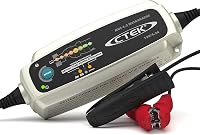
The CTEK MXS 5.0 suits someone who wants a compact 8-step program and a reconditioning function for a 12V lead-acid or AGM battery.
The Battery Tender Plus 1.25 Amp fits storage duty: leave it on a stored battery and let the small DC current keep it topped up.
If you want a charger that recovers a dead battery, the GENIUS5 also charges from as low as 1 volt. Whichever you choose, the rule stays the same: AC at the wall, DC at the clamps, and a charger that manages both sides.
What if you're still unsure whether battery chargers are AC or DC?
Check the label. Look for an AC input rating and a DC output rating, and you'll see the two sides of the same device separated clearly.
Chargers made for mains power all follow this pattern. A solar panel or a jump starter skips the wall side because it starts with DC.
Whichever you own, the battery terminals only ever see DC.
For the exact connection steps, use the guide on how to connect a battery charger to a battery. It walks through the order so the DC side is safe before the AC side goes live.
Frequently asked questions
Can I charge a battery straight from a wall outlet without a charger?
No. A wall outlet supplies AC at high voltage, and a battery needs low-voltage DC.
A charger or power supply does the conversion and controls the current, so never wire a battery directly to household power.
Why do some chargers say AC input and DC output on the label?
That label describes both sides of the charger. The AC input is the wall side and the DC output is the battery side.
It confirms the charger contains the converter, so you can plug it into a normal outlet and clip it to a DC battery.
Do portable power stations let me charge a battery away from an outlet?
Yes. A power station with a DC output, or one with a built-in charger, carries the DC side with it.
The charger or station still handles the conversion, so the battery never sees raw AC from the outlet.
Can I connect a charger through my car's 12V socket?
Sometimes, if the socket stays live with the ignition off and the charger is made for that route. The 12V socket is DC, so a compatible charger can feed through it.
Check that the socket is live and that the charger lists that connection.
Is a jump starter an AC or DC device?
A jump starter is DC on both sides. It stores DC in its internal battery and sends DC to the car battery, so it needs no AC conversion while jumping.
You recharge the jump starter itself from an AC outlet or a USB port.