Can a Battery Charger Go Bad?
Yes, a battery charger can go bad. Cords, clamps, internal electronics and the charging logic all wear out, and the usual result is a charger that won't power on, won't reach full charge, or won't stop charging. When that happens, the battery gets blamed first and the charger is the real fault.
On this page (9 sections)
- What are the signs a battery charger has gone bad?
- Why do battery chargers fail?
- How can you test a charger without guessing?
- When is the battery the problem, not the charger?
- Which parts of a charger fail first?
- Is it worth replacing a failed charger with a smart one?
- Which smart chargers handle a dead battery best?
- How can you stop a charger from going bad?
- So, can a battery charger go bad, and what should you do?
Yes, a battery charger can go bad. Cords, clamps, internal electronics and the charging logic all wear out, and the usual result is a charger that won't power on, won't reach full charge, or won't stop charging.
When that happens, the battery gets blamed first and the charger is the real fault.
The question "can a battery charger go bad" comes up most often when a battery that should be full keeps reading low. The trick is knowing which part failed and whether the charger or the battery is the one to replace.
What are the signs a battery charger has gone bad?
The clearest sign is a charger that behaves the same on every battery. If it won't light up, won't move the voltage, or shuts off within minutes no matter what you connect, the charger is the suspect.
One odd reading on one battery proves little.
Watch for these patterns:
- No lights at all when it's plugged into a known-good outlet.
- A fault or error light that stays on after you reseat the clamps.
- Voltage that doesn't rise after several hours on a battery you know is discharged.
- A charger that gets very hot or smells like hot plastic.
- A finish light that comes on instantly on a battery that cranked slowly this morning.
- A fan or transformer that hums loudly or clicks on and off.
Each of these points to a different failure inside the unit. Lights out usually means the power supply or cord.
Instant "full" usually means the sensing circuit. Heat and smell point at the transformer or the output stage.
Why do battery chargers fail?
Heat, moisture, worn cords and old capacitors do most of the damage. A charger that lives in a garage or on a boat sees wide temperature swings and damp air, which is hard on solder joints and insulation.
The electronics inside also age, even when the charger sits unused.
The most common causes break down like this:
- Cord and plug damage from being dragged, kinked or run over.
- Corroded clamps that no longer make clean contact.
- Overheating when a charger runs at full output for hours in a hot space.
- Moisture getting into an unsealed case and corroding the board.
- Capacitor aging that makes the output voltage drift or sag.
- Physical damage from a drop or a bent connector.
Cheap chargers cut corners on cooling and sealing, so they tend to fail sooner. Sealed smart units are built to handle dust and splashes, which is why they cost more.
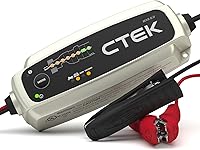
The CTEK MXS 5.0 carries an IP65 rating for splash and dust protection, so it tolerates the garage better than a bare transformer box.
How can you test a charger without guessing?
Test the charger on two different batteries and test each battery on a known-good charger. That swap is the fastest way to separate a charger fault from a battery fault.
It takes minutes and saves you from buying the wrong replacement.
Start with the basics. Check the outlet with a lamp or another device.
Inspect the cord for cuts and the clamps for rust or loose jaws. Then follow our guide on how to connect a battery charger to a battery so the clamps are clean and firmly seated.
Next, put a multimeter on the battery before charging. Write down the resting voltage.
Connect the charger and check the reading after an hour. A working charger should push the voltage upward.
A charger that leaves the reading flat, or drops it, has a problem.
Repeat with a second battery that you know holds charge. If both batteries fail to move on the same charger, the charger is the fault.
If one battery charges fine and the other doesn't, the battery is the fault.
Never test by touching the clamps together to "see if it sparks." That can short the output and damage a charger that was working.
When is the battery the problem, not the charger?
A battery that won't hold a charge is the more common failure, especially after 3 to 5 years. Chargers usually fail early or not at all.
Batteries age out, sulfate and lose capacity, so the charger gets blamed for doing its job.
Signs that point at the battery:
- The charger reaches full, but the battery drops to a low reading within a day or two.
- The battery cranks slowly in cool weather even after a full charge.
- The case looks swollen, or there's acid residue around the terminals.
- The battery is more than 4 years old and has been deeply discharged.
Sulfation is the usual culprit. Lead plates coat with sulfate crystals when a battery sits discharged, and that coating blocks the chemical reaction.
A smart charger with a pulse or repair mode can reverse light sulfation. NOCO says the GENIUS5 uses precision pulse charging to detect and reverse sulfation, which is worth trying before you scrap the battery.
If the battery is old and swollen, no charger will bring it back. Replace the battery and keep the charger.
Which parts of a charger fail first?
The cord, the clamps and the output electronics fail first. These are the parts that see handling, weather and heat.
Cords fail where they bend at the strain relief, and a kink there breaks strands inside the insulation.
Clamps fail when the jaws lose spring tension or the contact surfaces corrode. Both are easy to spot and sometimes easy to replace.
Inside the unit, the output stage and the capacitors take the heat. When they age, the charger's voltage sags under load.
That's why a failing charger often reads fine with no battery attached but can't push a real charge.
On a sealed smart charger, none of this is user-serviceable. NOCO backs the GENIUS5 with a 3-year warranty.
CTEK offers a limited warranty on the MXS 5.0. If a unit fails inside its warranty window, contact the maker rather than opening the case.
Is it worth replacing a failed charger with a smart one?
Yes, if the old unit was a basic transformer charger. A smart charger costs a little more, but it charges in stages, stops at full, and won't cook the battery.
That protects the battery and removes the most common cause of early charger failure.
A smart charger also fixes the "I forgot to unplug it" problem. The Battery Tender Plus 1.25 Amp uses a 4-step program and float charging to hold a battery at full without overcharging.
That's the behavior you want for a lawn mower or motorcycle that sits for weeks.
The trade-off is speed. At 1.25 amps, the Battery Tender Plus is a maintainer first.
It's the wrong tool for a big, deeply discharged battery you need back today. For that, you want more current.
Which smart chargers handle a dead battery best?
A charger with a repair mode and a low-voltage start is the best pick for neglected batteries. That combination lets you recover a deeply discharged battery instead of replacing it.
It also gives you a safe way to leave the charger connected long term.
The NOCO GENIUS5 is the strongest all-rounder here. It charges 6-volt and 12-volt lead-acid and lithium-ion batteries and starts on batteries as low as 1 volt.
A Force Mode lets you manually charge a battery down to zero volts. Its thermal sensor adjusts the charge with temperature, so it won't overcharge in summer or undercharge in winter.
At 5 amps, it's quick enough for a car battery and gentle enough to leave connected. NOCO says it can stay attached indefinitely for maintenance.
It suits anyone who wants one charger for cars, motorcycles and deep-cycle batteries.
The CTEK MXS 5.0 is the pick for cold climates and harsh garages. It's a 4.3 amp, 12-volt unit with an 8-step program and a reconditioning function.
CTEK says its float and pulse charging lets you leave it connected for months. The IP65 rating covers splashes and dust.
If you need more current for a truck or a bank of batteries, step up to a 10 amp battery charger. For a big diesel rig, our picks for the best battery charger for a diesel truck cover the higher-output options.
And if you're weighing a small maintainer against a full charger, our trickle charger vs battery maintainer comparison explains the difference.
How can you stop a charger from going bad?
Keep it dry, keep it cool, and don't yank the cord. Most charger failures come from handling and environment, not from use.
A few habits add years to the unit.
- Coil the cord loosely and store it off the floor.
- Keep the charger out of puddles and away from rain.
- Don't run it at full output in a closed, hot space for hours.
- Clean and dry the clamps after use on a dirty battery.
- Unplug by the plug body, not by pulling the cable.
A smart charger also reduces wear on itself. It tapers current as the battery fills, so it isn't running flat out the whole time.
That's one more reason the upgrade pays for itself.
So, can a battery charger go bad, and what should you do?
Yes, a battery charger can go bad. Test it on two batteries before you spend money.
If the charger won't light up, won't raise voltage or won't stop charging, replace it. If it charges one battery and not another, the battery is the fault.
When you replace a failed unit, go smart. The NOCO GENIUS5 is the best all-rounder for most readers, with a force mode for dead batteries and temperature sensing for year-round safety.
Pick the CTEK MXS 5.0 if the charger lives in a cold or dusty garage. Choose the Battery Tender Plus 1.25 Amp for long-term motorcycle, ATV or lawn mower storage.
Then read our guide on how to connect a battery charger to a battery so the new unit gets a clean start.
Frequently asked questions
How long does a battery charger usually last?
There's no fixed lifespan. Chargers differ in build quality and sealing, and storage and heat matter more than age.
A sealed smart charger with dust and splash protection handles a garage or boat better than an open unit.
Can a bad charger damage a good battery?
Yes. An unregulated charger that keeps pushing current can overcharge a battery and boil off electrolyte.
A charger with reversed clamps or a shorted lead can also stress it.
A smart charger with temperature sensing is the safer choice.
Why does my charger show a full charge when the battery is flat?
That usually means the charger's voltage sensing or its internal reference has drifted. It reads the surface voltage and shuts off early.
Try another battery on the same charger to confirm before you replace either one.
Is it worth repairing a failed battery charger?
Usually not for budget units. Parts and labor often cost more than a replacement.
Sealed smart chargers are rarely serviceable anyway.
Replace the unit and keep the clamps and cables if they still fit your next charger.
Can I leave a charger plugged in all the time?
Only a maintainer-rated smart charger should stay connected indefinitely. A basic charger should be unplugged once the battery reaches full charge.
NOCO says the GENIUS5 can stay connected safely for maintenance, which is different from a plain charger.