How Long Should You Keep a Battery Charger On?
A smart charger or maintainer can stay connected for weeks or even months, while a basic charger should come off once the battery is full. Leave a simple charger on too long and the battery overheats and dries out, so match the time to the charger you own.
On this page (8 sections)
- How long can you leave each type of charger on?
- Why does leaving a basic charger on too long damage a battery?
- How long does a typical battery take to charge?
- Can you leave a smart charger connected indefinitely?
- Is it safe to leave a charger on overnight or while you sleep?
- Which charger fits long-term storage?
- When should you unplug a basic charger?
- How do you decide how long to keep the charger on?
A smart charger or battery maintainer can stay connected for weeks or months without harming the battery. A basic charger needs to come off once the battery is full, usually within a few hours.
The question of how long to keep a battery charger on comes down to one thing: does your charger stop or taper when the battery fills?
A plain trickle charger is a middle case. It's slow enough that leaving it on overnight is usually fine, but leaving it connected for weeks is not.
Knowing which type you own is the whole answer.
How long can you leave each type of charger on?
**Smart chargers and maintainers: weeks to months. Basic chargers: hours.
Trickle chargers: overnight, not much longer.** The charger's own behavior decides the safe window, so check what yours does at full charge before you walk away.
A smart charger monitors voltage and drops to a float or pulse stage when the battery fills. That's why makers design them for long-term connection.
A basic transformer charger just keeps pushing current, so the battery keeps heating. A trickle charger delivers a small fixed current that's safe for a night but not for a season.
If you don't know which type you have, look for a float stage in the manual or a charge-status light that changes when the battery is full. No taper means no long-term use.
Why does leaving a basic charger on too long damage a battery?
A basic charger keeps feeding current after the battery is full, and that current turns into heat and gas. The electrolyte loses water, plates corrode, and the battery's life shortens.
Overcharging is the most common way a good battery gets ruined.
Lead-acid batteries accept less and less current as they fill. A smart charger senses that and backs off.
A simple charger can't, so the extra energy has nowhere to go except into warming the case and bubbling off water. Sealed AGM batteries can't be topped up, so the damage is permanent.
The signs show up over time: a swollen case, a hot charger, a sulfur smell, or a battery that won't hold a charge. Unplugging a basic charger when the ammeter nears zero is the simple guard against all of it.
How long does a typical battery take to charge?
A 5-amp charger fills a typical 60 amp-hour car battery in roughly 8 to 12 hours from half charge. A 1.25-amp maintainer needs several times longer, and a deeply discharged battery takes longer still.
Battery size and depth of discharge set the real number.
Charge time is amp-hours divided by charger amps, plus some extra for the taper at the end. A 5-amp charger on a 60 amp-hour battery that's half down needs about 6 hours in theory and more in practice.
The NOCO GENIUS5 lists an 8-hour charge time, which fits that pattern for a mid-size battery.
The CTEK MXS 5.0 lists a 50-hour charge time in its specifications, which reflects a slow, staged 8-step program rather than a fast bulk charge. Small powersport and motorcycle batteries fill much faster because there's less capacity to replace.
Can you leave a smart charger connected indefinitely?
Yes. A smart charger that switches to float or pulse mode is built to stay connected without overcharging.
NOCO says the GENIUS5 can be left connected safely and indefinitely, and CTEK calls its MXS 5.0 a set-and-forget charger for months at a time.
That's the main reason to buy one.
The float stage holds the battery at a safe voltage, topping up only what self-discharge takes away. Pulse charging on some models also helps reverse sulfation on a battery that sat low.
For a stored car, boat, or motorcycle, this is the difference between a battery that starts in spring and one that needs replacing.
If you're deciding between a small maintainer and a full charger, our guide to when you should use a trickle charger walks through the use cases. The short version: a maintainer is for keeping a healthy battery healthy, not for reviving a dead one.
Is it safe to leave a charger on overnight or while you sleep?
It's safe with a smart charger or a maintainer, because they stop charging at full voltage. A basic charger left unattended overnight is the risky case.
Heat and gas build up while you're not watching, so unplug it before bed.
Safety basics apply either way. Keep the charger off damp floors, away from flammable material, and in a spot with some airflow.
Don't cover it, and check that the clamps are tight and not reversed. A spark near a battery can ignite the gas it gives off while charging.
If your charger has no automatic shutoff, a plug-in timer set for a few hours is a cheap safeguard. For a long storage period, a dedicated maintainer is the better tool.
Our comparison of trickle charger vs battery maintainer explains why the two behave so differently over weeks.
Which charger fits long-term storage?
A smart maintainer is the right pick for months of storage, while a basic charger is fine for a one-off top-up. The NOCO GENIUS5 leads here for its wide battery support and its stated ability to stay connected indefinitely.
The CTEK MXS 5.0 suits cold-climate storage and reconditioning.
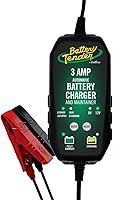
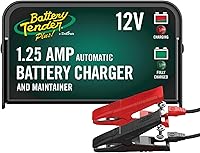
The Battery Tender Plus is the simple, low-amp choice for a motorcycle or a weekend car.
The GENIUS5 handles 6-volt and 12-volt lead-acid and lithium-ion batteries, charges from as low as 1 volt, and has a force mode for completely dead batteries. A thermal sensor adjusts the charge to the temperature, which matters in a cold garage or a hot one.
It's the most flexible of the three for mixed vehicle fleets.
The MXS 5.0's 8-step program includes a reconditioning function for underperforming batteries. It's rated IP65 for splash and dust protection, so a damp garage or a marine setting won't stop it.
Its float and pulse charging lets it sit connected for months, which is why CTEK calls it set and forget.
The Battery Tender Plus runs a 4-step program at 1.25 amps. That's gentle enough for a motorcycle battery and slow for a large truck bank.
Its two-color LED shows charge state and resumes full output when voltage drops under load. For a small battery in long storage, that's all you need.
When should you unplug a basic charger?
Unplug a basic charger as soon as the ammeter drops near zero or the battery reaches about 14.4 volts. That's usually within 4 to 8 hours for a car battery, depending on size and starting charge.
Don't leave it running past that point.
Check the gauge every couple of hours on the first charge so you learn how your charger behaves. A warm case is normal; a hot one or a smell of sulfur means stop.
If you'll be away, use a timer rather than trusting the charger to shut itself off.
For a battery you only use seasonally, a basic charger plus a timer is workable. For anything that sits for months, a smart charger takes the guesswork out.
Our comparison of Schumacher vs Battery Tender helps if you're choosing between those two brands for storage duty.
How do you decide how long to keep the charger on?
Match the time to the charger, not the clock. A smart charger can stay connected for months, a maintainer all winter, and a basic charger only until the battery is full.
That's the whole answer to how long to keep a battery charger on, and it's the one rule that protects your battery.
Pick the NOCO GENIUS5 if you want one charger for cars, motorcycles, and lithium packs with indefinite connection. Choose the CTEK MXS 5.0 for cold-weather storage or a battery that needs reconditioning.
Go with the Battery Tender Plus for a motorcycle or weekend car that just needs a gentle float.
Whichever you choose, read what the charger does at full charge before you leave it connected. That single detail decides whether "leave it on" means overnight or all season.
Frequently asked questions
Can I leave a battery charger on overnight?
Yes, if it's a smart charger or maintainer that stops charging at full voltage. A basic charger left on overnight can overcharge a battery, so unplug it once the meter shows a full charge or use a timer.
Does leaving a charger on longer charge a battery more?
No. Once a battery reaches full voltage, extra charging only heats it and drives off water.
A smart charger switches to float mode at that point, so extra time does no harm but adds no charge either.
Can I leave a battery maintainer connected all winter?
Yes. A maintainer holds a full battery at a safe float voltage and can stay connected for months.
That's the point of a maintainer: it keeps the battery topped up without the overcharge risk of a plain charger.