How to Use a Portable Battery Charger
To use a portable battery charger, connect the clamps to the battery (positive first, negative last), plug the charger into a wall outlet, and let the automatic program run until the status light shows full. Then switch the charger off and remove the negative clamp before the positive.
On this page (8 sections)
- What should you check before you connect a portable battery charger?
- How do you connect the clamps or ring terminals correctly?
- Which charge rate should you pick for your battery?
- How do you start the charge and know when the battery is full?
- How do you disconnect and remove the charger safely?
- When is a portable charger the wrong tool for the job?
- What is the difference between a portable charger and a trickle charger?
- Which portable battery charger fits your battery?
To use a portable battery charger, connect the clamps to the battery (positive first, negative last), plug the charger into a wall outlet, and let the automatic program run until the status light shows full. Then switch the charger off and remove the negative clamp before the positive.
The steps look simple, but the order of the connections and the choice of charge rate are what keep the job safe. This guide walks through how to use a portable battery charger on a car, motorcycle or powersport battery without overcharging it.
What should you check before you connect a portable battery charger?
Check the battery voltage and the charger's output match before touching the clamps. A 12V charger on a 6V battery, or the reverse, can damage the battery or the charger.
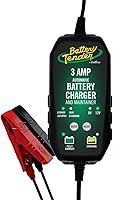
Look at the battery label for its voltage and chemistry: flooded lead-acid, AGM or gel. Most smart chargers handle all three, but the Battery Tender Junior states compatibility with 12V lead-acid, flooded, AGM and gel cells.
CTEK's US 0.8 is built for 12V lead-acid batteries too.
Inspect the battery case for cracks, swelling or leaking acid. Check that the terminals are tight and clean, since a loose clamp on a corroded post causes a poor connection and false readings.
Keep the charger and its leads away from fuel vapors and wear eye protection if acid is present.
Confirm the charger's plug reaches an outlet without strain. A garage outlet with a ground fault circuit interrupter is the safer choice near a wet floor.
The charger body itself matters here. The Battery Tender Junior is only 3.3 x 1.3 x 2.4 inches and about 1 lb, so it sits on a shelf or fender without a long cable run.
The CTEK US 0.8 is splash and dustproof, which helps on a damp garage floor but is not a reason to skip the ventilation check.
How do you connect the clamps or ring terminals correctly?
Attach the positive clamp to the positive terminal first, then the negative clamp to the negative terminal, and only then plug the charger in. Reversing that order risks a spark near the battery.
Match the clamp colors to the terminal marks: red to positive (+), black to negative (-). The Battery Tender Junior includes a fused-ring terminal harness for hard-to-reach batteries plus alligator clip cables.
The CTEK US 0.8 ships with clamps and an eyelet connector.
If you use ring terminals, bolt the fused lead to the terminal and leave the quick connector hanging where you can reach it. That setup suits a battery you charge often.
For a one-off charge, clamps are faster.
A smart charger with reversed-hookup detection, like the Battery Tender Junior, checks polarity and refuses a wrong connection. The CTEK US 0.8 is reverse polarity protected and short-circuit proof as well.
How do the ring terminal setup and the quick disconnect differ?
The Battery Tender Junior's fused-ring harness bolts to the posts and ends in a connector you unplug, so the clamps never touch the battery on a regular top-up. The Battery Tender Plus ships a quick disconnect harness that does the same job on a car, motorcycle or lawn mower battery.
The CTEK US 0.8 eyelet connector works the same way and can stay fixed to the battery. Pick the ring or eyelet route when the battery sits under a seat or in a tight bay, and keep the alligator clips for a battery you only charge once in a while.
Which charge rate should you pick for your battery?
Match the charge rate to the battery's size: a low amp rate for small powersport batteries, a higher one for car and larger motorcycle batteries. Too high a rate heats a small battery; too low a rate takes all day on a big one.
The Battery Tender Junior runs at 750mA, which the maker positions for 3–30Ah batteries in motorcycles, ATVs, UTVs, scooters, PWCs and snowmobiles. It charges a small 3–5Ah battery overnight and a 14–20Ah motorcycle battery in roughly 14–22 hours.
The Battery Tender Plus 1.25 Amp raises the output to 1.25A, so it suits larger motorcycle batteries and car batteries during storage. CTEK's US 0.8 sits at 0.8A and is aimed at smaller 12V batteries as well as maintenance charging on normal-sized ones.
If your battery is a large diesel bank or deeply drained, a higher-output charger will recover it faster than any of these three. Battery Tender notes that large diesel battery banks may charge slowly with the Plus, and points to a higher-output charger for faster recovery.
How do you start the charge and know when the battery is full?
Plug the charger into the outlet after the clamps are set, and let the automatic program run without interrupting it. Most smart chargers start with a check, move into bulk charge, then absorb and float.
Battery Tender's 4-step program runs initialization, bulk charge, absorption mode and float mode. The two-color LED shows the charge state, and the charger resumes full output if battery voltage drops under load.
CTEK's US 0.8 uses a 6-step program and is designed for no overcharge or undercharge.
A full charge shows on the light per the charger's own label. Leave an automatic maintainer connected for storage; it will drop to float and only top up as needed.
The Battery Tender Junior is designed to sit on a motorcycle all winter without damaging the battery.
The same logic carries over to a car. Battery Tender says the Plus 1.25A suits classic, seasonal and weekend vehicles and exotic cars with AGM batteries.
It is not a fast charger for a big drained battery, but it is built for the slow storage top-up.
How do you disconnect and remove the charger safely?
Turn the charger off and unplug it from the wall first, then remove the negative clamp, then the positive. That order keeps any spark away from the battery.
Pull the clamps straight off the terminals rather than twisting them. If you used ring terminals, unbolt the fused lead and tuck it clear of moving parts.
Store the cables loosely coiled, not wrapped tight around a sharp edge.
Check the terminals for corrosion after a long charge and clean them if needed. Reconnect the vehicle's cables if you disconnected them, positive first.
Start the engine and confirm the battery holds a charge.
If the vehicle sat for the season, also check that the charger's light behaved as expected during the charge. A light that never reaches the full state can mean a weak battery rather than a faulty charger.
When is a portable charger the wrong tool for the job?
A portable charger is the wrong tool when the battery is dead enough to need a jump start or when the vehicle won't start at all. A charger brings a battery up slowly; a jump pack or jumper cables get you moving now.
If the battery reads below 2V or has sat discharged for months, a low-amp charger may not recover it. The Battery Tender Junior can recover most deeply discharged batteries using low-voltage recovery at startup, but batteries left too long may not come back.
For a battery in that state, a jump start gets the car home and a replacement may be the better buy.
Also skip a portable charger for a battery that is cracked, leaking or hot to the touch. Charge a healthy battery only.
What is the difference between a portable charger and a trickle charger?
A portable smart charger controls its output and drops to float when full, while a basic trickle charger feeds a constant small current. That constant feed can overcharge a battery left connected for weeks.
The Battery Tender Junior is described as smarter than a trickle charger because it switches to float mode and only charges when needed. Battery Tender makes the same claim for the Plus.
The trickle charger vs battery maintainer comparison breaks down which one suits storage and which suits a top-up.
If your plan is long-term storage rather than a one-off charge, read when should I use a trickle charger before you leave anything connected. The guide to using a trickle charger covers the storage routine step by step.
Which portable battery charger fits your battery?
Pick a low-amp smart maintainer for powersport batteries and a higher-amp one for car and large motorcycle batteries. The charge rate should match the battery's amp-hour rating, not the vehicle's size.
The CTEK US 0.8 has one feature the Battery Tender units do not list: a patented desulphation function that analyzes the battery and tries to recover it when sulphation has set in. That makes it a reasonable pick for an older battery that has sat unused, though it still cannot revive one beyond saving.
For most riders charging a motorcycle or ATV battery, the Junior at 750mA is the right match. Pick the Plus when the battery is bigger or drains faster.
Pick the CTEK when you want a desulphation function and a compact, splash-proof unit. Whichever you choose, the order of the steps is what makes how to use a portable battery charger a safe job.
Measure your battery's amp-hour rating first, then pick the charger that matches it. Keep the clamps clean, connect positive first, and let the automatic program finish the job.
Frequently asked questions
Can you leave a portable battery charger connected overnight?
Yes, if the charger is an automatic maintainer that switches to float mode. The Battery Tender Junior and Plus both step down to float once the battery is full, so they can stay connected for storage.
A basic constant-current charger should be unplugged when the light says full.
Do you have to remove the battery to charge it?
No. Most smart chargers connect with alligator clips right on the car, and the CTEK US 0.8 is designed to be used without disconnecting the battery.
Clamp in a ventilated spot, keep the charger off the ground, and close the hood once the leads are clear.
How long does a portable battery charger take to charge a car battery?
It depends on the charge rate and how empty the battery is. A 1.25 A charger like the Battery Tender Plus takes many hours on a large car battery, while the 0.75 A Junior is aimed at smaller 3–30Ah powersport batteries.
A deeply discharged battery needs longer in every case.
What does the flashing or two-color light mean?
The light shows the stage of the charge, not a fault unless the maker says so. Battery Tender uses a two-color LED that shows the charge state and resumes full output if voltage drops.
Read the charger's own label for what each color means before you assume the battery is bad.