What Size Battery Maintainer Do You Need?
Choose a battery maintainer by battery voltage, chemistry and the maker’s recommended charge rate. For routine storage, a low-current smart maintainer can suit a small battery, while a larger battery or a faster recharge may call for more output.
On this page (8 sections)
- What size battery maintainer do I need for storage?
- How do amps relate to battery capacity?
- Does battery type change the size you need?
- How much output do motorcycles and small batteries need?
- When does a 3 amp maintainer make sense?
- How do you choose between 1.25, 3, 5 and 10 amps?
- What should you check before connecting a maintainer?
- Which battery maintainer size should you pick?
Choose a battery maintainer by battery voltage, chemistry and the battery maker’s recommended charge rate. For routine storage, a low-current smart maintainer can suit a small battery, while a larger battery or a faster recharge may call for more output.
A maintainer is meant to keep a charged battery ready while it sits. It is not a shortcut for choosing a charger that can recover a deeply discharged battery, and the number of amps alone does not tell you whether it fits.
If you’re comparing charge rates for a car battery, see our guide to how many amps you need to charge a car battery. For the basic operating cycle, read how a battery maintainer works.
What size battery maintainer do I need for storage?
For storage, choose the lowest output that supports your battery and can keep up with its normal self-discharge and vehicle drain. Check the battery type, voltage and capacity against the charger’s supported range before buying.
A car with an alarm or other always-on electronics may draw more power while parked than a disconnected battery. That can affect the output you need, so check the vehicle manual or ask a qualified shop if you do not know its storage draw.
Use these as starting points, not fixed rules:
| Battery and use | Starting point | What to check |
|---|---|---|
| Small motorcycle or powersports battery | Around 1 to 2 amps | Supported battery capacity, chemistry and connector |
| Car battery in seasonal storage | Around 1 to 5 amps | Battery type, vehicle draw and automatic maintenance mode |
| Larger battery or faster recovery | 5 amps or more | Battery maker’s charge-rate guidance and charger mode |
A small maintainer can take a long time to replace a large charge loss. If a battery is already weak or deeply discharged, choose a charger with a suitable recovery function rather than expecting a maintenance mode to solve the problem.
How do amps relate to battery capacity?
Amps describe how quickly a charger can supply current, while amp-hours describe a battery’s capacity. A higher amp number can shorten charging time, but it does not by itself make a charger suitable for a given battery.
A rough estimate for replacing a known charge loss is:
Charging time in hours ≈ amp-hours to replace ÷ charger amps
Real charging takes longer because output changes during the charge and some energy is lost. This estimate also does not account for the vehicle’s electrical draw or tell you whether the battery can accept the selected rate.
For example, a 5 amp charger can generally supply more current than a 1.25 amp charger. That makes it a more flexible choice when you want both maintenance and charging, if its voltage and chemistry settings fit your battery.
Why can a higher amp maintainer be the wrong choice?
A higher-output maintainer is the wrong choice if its charge profile does not match your battery. More current cannot make an unsupported chemistry safe to charge.
Check the instructions for charge modes and the battery capacity range. A charger that supports lead-acid batteries may not support lithium, and a 12V charger is not automatically correct for every 12V chemistry.
Also consider how you will use it. A compact, lower-current unit can be easier to keep with a motorcycle, while a higher-output charger may be more useful for a car battery that needs charging as well as maintenance.
Does battery type change the size you need?
Yes. Match voltage and chemistry first, then compare capacity and charge rate.
Different batteries may need different charging modes even when both are described as 12V.
Lead-acid batteries include flooded, AGM and gel types. Lithium batteries, such as LiFePO4, need a charger that explicitly supports that chemistry.
A maintainer’s listed current is only one part of the fit. Confirm that its supported voltage and battery types match the label on your battery, and follow the battery maker’s instructions.
What should you choose for an AGM or flooded battery?
For an AGM or flooded battery, use a charger that names the battery type and voltage. Many smart chargers support more than one lead-acid type, but verify the exact mode and capacity range in the manual.
The NOCO GENIUS5 offers 5A output and supports 6V and 12V lead-acid and LiFePO4 batteries. Its integrated thermal sensor adjusts charging based on ambient temperature.
For a smaller powersports battery, a lower-current option may be a closer match. Compare its supported capacity to your battery rather than choosing by vehicle name alone.
What should you choose for a lithium battery?
For lithium, use a charger that explicitly supports your battery’s lithium chemistry and voltage. Do not assume a lead-acid mode is suitable just because the battery voltage looks similar.
The NOCO GENIUS10 supports 6V and 12V lead-acid and LiFePO4 batteries, with 10A output. That output can be useful when you need a charger for both maintenance and a faster charge, as long as the battery’s own instructions allow it.
If your battery is a different lithium chemistry, check with its maker before connecting a charger. The word “lithium” alone is not enough to confirm compatibility.
How much output do motorcycles and small batteries need?
Motorcycle batteries often have less capacity than car batteries, so a low-current maintainer may be a better fit for long storage. Check the battery’s chemistry, capacity and connector before choosing.
The Optimate 4 Quad Program is rated at 1.25A. It supports 12V AGM, gel and standard batteries from 4 to 60Ah, plus LiFePO4 batteries from 2 to 15Ah.
Its programs include options for charging through compatible BMW CAN-bus or Triumph live 12V sockets, as well as direct battery connections. Those socket options matter only if your motorcycle and socket are compatible.
For more motorcycle options, see our best battery chargers for motorcycles and powersports guide. If you store a car for long periods, compare the choices in our best car battery maintainers for cars that sit.
When does a 3 amp maintainer make sense?
A 3 amp maintainer can suit a car or truck battery when you want moderate output for charging and ongoing maintenance. Confirm that its voltage and chemistry settings match your battery.
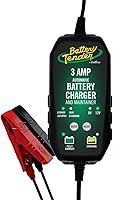
The Battery Tender 3 Amp supports 6V and 12V batteries and has a float mode for maintenance. Its listed compatibility includes lead-acid, AGM and gel batteries; the supplied facts do not guarantee lithium support, so choose another unit for a lithium battery unless the manufacturer confirms compatibility.
This option includes ring terminal and alligator clip connections. Pick the connection style that works with your battery location and how often you plan to connect or remove the charger.
How do you choose between 1.25, 3, 5 and 10 amps?
Choose 1.25A for compatible small batteries and storage, 3A for moderate charging and maintenance, 5A for broader charging needs, and 10A when you want more output and your battery supports it. These are product examples, not universal minimums.
| Output | Example here | A sensible fit when |
|---|---|---|
| 1.25A | Optimate 4 Quad Program | Battery is within its stated capacity and chemistry ranges |
| 3A | Battery Tender 3 Amp | You have a compatible 6V or 12V lead-acid, AGM or gel battery |
| 5A | NOCO GENIUS5 | You want a 6V or 12V unit with supported lead-acid or LiFePO4 modes |
| 10A | NOCO GENIUS10 | You need more output and the battery supports the selected mode |
The right row depends on your battery, not just whether it belongs to a car, boat or motorcycle. Capacity and chemistry vary within each vehicle group.
What should you check before connecting a maintainer?
Before connecting, verify the voltage, chemistry, polarity and connection method. Follow the charger and vehicle instructions, especially when the battery stays installed.
- Read the battery label for voltage and chemistry.
- Check the maker’s recommended charge rate or capacity range.
- Confirm that the charger has a mode for the battery type.
- Check whether you can use battery clamps, ring terminals or an approved vehicle socket.
- Follow the manual’s connection and storage directions.
If you are unsure about the connection points, see how to connect a battery maintainer step by step. For a broader look at ongoing use and precautions, read whether battery maintainers are safe to leave connected.
Which battery maintainer size should you pick?
Pick a low-current unit for a compatible small battery kept in storage, and more output when you need faster charging or have a larger battery. In every case, let the battery maker’s voltage, chemistry and charge-rate guidance decide the final fit.
The Optimate 4 Quad Program is the lowest-output option here, while the NOCO GENIUS10 offers the most current. Compare the battery support and connection method before choosing between them.
If your main need is routine car storage, use our car maintainer guide to compare more options. If you’re still weighing output, the 10 amp charger guide covers a higher-current class.
Frequently asked questions
What size battery maintainer do I need for a car?
For a typical 12V car battery kept in storage, a smart maintainer in the 1 to 5 amp range is a common place to start, provided it supports the battery’s chemistry and capacity. Check the vehicle and battery maker’s guidance, especially for AGM or lithium batteries.
Is a 10 amp maintainer too big for a car battery?
A 10 amp charger is not automatically too large, but it may be more output than needed for long-term maintenance. Confirm that its automatic maintenance mode and charging profile suit your battery, then follow the battery maker’s recommended charge rate.
Can I use a 1.25 amp maintainer on a car battery?
A 1.25 amp maintainer may maintain a compatible, healthy battery during storage, but it will take longer to replace a large charge loss than a higher-output charger. Check its supported battery capacity and chemistry before connecting it.
Does battery chemistry affect maintainer size?
Yes. Match the maintainer to the battery chemistry as well as its voltage and capacity; lead-acid, AGM and LiFePO4 batteries can require different charging profiles.
Use a charger with a mode approved for your exact battery type.
Can I leave a battery maintainer connected?
A smart maintainer designed for ongoing maintenance can be left connected as its instructions allow. Check the manual for the exact battery type, connection method and storage conditions, and use a safe, dry location with suitable ventilation.