How Many Amps to Charge a Car Battery?
For most 12V car batteries, a 4–10 amp charger is a practical range for routine charging. Lower current is gentler and takes longer, while a higher rate can help when you need a quicker charge and your battery supports it.
On this page (7 sections)
- How many amps to charge a car battery?
- Does a higher amp charger charge faster?
- Is 2 amps enough to charge a car battery?
- What charger amperage fits a typical car battery?
- Should you use a trickle charger or a fast charger?
- How do you choose the right amps for your battery?
- How many amps should you use to charge a car battery?
For most 12V car batteries, a 4–10 amp charger is a practical range for routine charging. A lower rate takes longer, while a higher compatible rate can help when you need to charge sooner.
The right amperage depends on the battery's capacity, condition, chemistry, and the instructions from its maker. Use those instructions to choose a rate, and don't treat a charger's maximum output as the right setting for every battery.
How many amps to charge a car battery?
Use the charging rate recommended in your battery manual; 4–10 amps is a useful starting range for many 12V car batteries. Smaller batteries may call for less current, and a larger or deeply discharged battery may need more time at a moderate rate.
Amps measure the rate of current flowing into the battery. They don't tell you exactly how long charging will take, because a smart charger may change its output as the battery fills.
For a car that sits between drives, a low-current maintainer may suit long-term upkeep better than a high-rate charging session. See our guide to what size battery maintainer you need if you're choosing equipment for storage.
Does a higher amp charger charge faster?
A higher compatible amp setting can charge faster, but the battery and charger must both support it. Charging isn't always a simple division of battery capacity by amps, since the actual rate changes during the charging cycle.
For example, a 10 amp charger doesn't necessarily supply 10 amps for the entire session. Smart chargers can adjust their charging stages, and a nearly full or deeply discharged battery may take longer than a basic estimate suggests.
If speed matters, choose a charger with a suitable higher output and follow its instructions. Our guide to 10 amp battery chargers compares options around that rate.
Is 2 amps enough to charge a car battery?
A 2 amp charger can charge a car battery, but it usually takes longer than a higher-rate charger. It may be a fit when you have time and the battery instructions allow that rate.
Some chargers offer multiple settings. The Battery Tender 15 Amp has selectable 15, 8, and 2 amp output, plus a float mode after charging.
Its range gives you options, but pick the setting that matches your battery's guidance.
A slow rate doesn't make a damaged or frozen battery safe to charge. Check the battery for cracks, leaks, swelling, or other visible damage, and follow the charger manual's safety steps.
What charger amperage fits a typical car battery?
A charger with selectable output or smart charging can make it easier to match the rate to your battery and schedule. Confirm that it supports your battery's voltage and chemistry before use.
The NOCO GENIUS10 is a 10 amp charger for 6V and 12V lead-acid batteries, including AGM, gel, and flooded types, as well as LiFePO4 lithium batteries. Its thermal sensor adjusts charging based on ambient temperature.
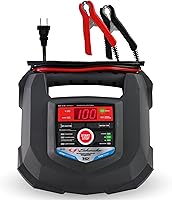
The Schumacher SC1280 provides 15 amp charging for compatible 6V and 12V standard, AGM, gel, and deep-cycle batteries. Its microprocessor control includes automatic voltage detection and multi-stage charging.
The Clore PL2310 offers 2, 6, and 10 amp charge rates for 6V and 12V batteries. It also has a stable power supply mode for maintaining system voltage in applications that need it.
For more options at the 10 amp level, compare our best 10 amp battery chargers. If your battery is fully discharged, read how to charge a dead car battery at home before connecting a charger.
Should you use a trickle charger or a fast charger?
Use a slower charger when you can leave the battery charging longer, and a higher compatible rate when time matters. For long periods of storage, a maintainer designed for that purpose can keep a battery charged without treating every session as a fast charge.
A trickle charger supplies a low current over time. Some models are automatic, while others need closer attention, so read the instructions before leaving one connected.
If you're comparing charging methods, see how to use a trickle charger on a car and how a battery maintainer works. The best choice depends on whether you need to restore charge now or keep a parked car's battery topped up.
How do you choose the right amps for your battery?
Start with the battery manual, then match the charger's voltage, chemistry, and output to its guidance. If the manual doesn't give a clear rate, contact the battery maker before using a high-current setting.
Check these points before charging:
- Confirm the battery is 6V or 12V and that the charger matches it.
- Check whether the battery is lead-acid, AGM, gel, flooded, or lithium.
- Use a current setting approved for that battery type and size.
- Inspect for damage and charge in the location recommended by the manuals.
- Stop if the charger reports an error or the battery behaves abnormally.
A charger with several output settings can suit different batteries, but it doesn't replace checking compatibility. For lithium batteries, read what kind of charger a lithium battery needs.
How many amps should you use to charge a car battery?
For many routine 12V car-battery jobs, start by considering a compatible 4–10 amp rate and follow the battery manual. Choose a lower rate when you have time, or a higher one only when the battery supports it.
A 2 amp setting can work for slower charging. A 15 amp charger may be useful for a compatible battery when time matters, but the number alone doesn't tell you how quickly charging will finish.
Pick the charger for your battery's chemistry and voltage first, then use the approved current setting. If the car will sit unused, a suitable maintainer may be the better fit than repeated fast charging.
Frequently asked questions
How many amps should I use to charge a car battery?
For routine charging, a 4–10 amp setting is a useful range for many 12V car batteries. Check the battery and charger manuals for the approved rate, then choose a lower setting for slow charging or a higher compatible setting when time matters.
Battery size, condition, temperature, and charger behavior affect the time.
Is 10 amps too much to charge a car battery?
A 10 amp rate is not automatically too high, but compatibility depends on the battery and charger. Check both manuals before connecting, especially for a small battery or a chemistry-specific charging mode.
A smart charger can manage its charging stages, but it still needs to match the battery.
Can I charge a car battery at 15 amps?
Some chargers offer a 15 amp mode for compatible batteries, but the battery maker's instructions decide whether that rate is suitable. Higher current can shorten charging time, though actual time varies as the charger changes its output.
Don't use a charger setting that exceeds the battery's guidance.
How long does it take to charge a car battery at 10 amps?
There is no single time for every battery. A 10 amp charger may need several hours, and charging can take longer if the battery is deeply discharged, large, cold, or aging.
The charger's automatic stages can also reduce current as the battery approaches full charge.