How Does a Battery Maintainer Work?
A battery maintainer charges a battery, then monitors its voltage and adjusts or pauses charging to help keep it ready between uses. Use one that matches your battery type and follow the battery and charger instructions.
On this page (9 sections)
- How does a battery maintainer work?
- Why does a parked vehicle's battery lose charge?
- How is a maintainer different from a trickle charger?
- What should you check before choosing a maintainer?
- Which maintainers fit common battery needs?
- Can a maintainer stay connected during storage?
- How do you connect a battery maintainer?
- What should you do if the maintainer won't charge?
- How does a battery maintainer work for your vehicle?
A battery maintainer charges a battery, then monitors its voltage and adjusts or pauses charging to help keep it ready between uses. Use one that matches your battery type and follow the battery and charger instructions.
That makes it useful for a car, motorcycle, or other vehicle that sits for weeks. It isn't a jump starter, and it may not be the right tool for bringing a severely discharged or damaged battery back to health.
How does a battery maintainer work?
A smart battery maintainer senses the battery's charge and changes how it supplies current as the battery fills. Many charge at a higher rate at first, then shift to a lower-current maintenance or float mode when the battery is near full.
The charger connects to the battery terminals and checks electrical conditions. Its control circuit uses those readings to manage charging, rather than delivering the same output continuously.
In maintenance mode, the charger can keep the battery near its target voltage. Some models resume charging if the voltage falls under load or over time, while others use different monitoring methods.
What happens during charging and maintenance?
A maintainer typically moves through stages: it supplies charge, checks progress, and reduces or pauses output when the battery is sufficiently charged. Exact stages and names vary, so use the manual for the model you own.
A useful distinction is that maintenance mode is not necessarily zero current. The charger may provide small amounts of current to offset normal battery drain or power use, then pause again when conditions allow.
A maintainer is generally intended to keep a serviceable battery charged during storage. It does not repair a failed battery, and it may not be able to start charging one that is deeply discharged.
Why does a parked vehicle's battery lose charge?
A parked vehicle's battery can lose charge from normal self-discharge and small electrical loads. Alarm systems, clocks, keyless-entry systems, and other electronics may keep drawing power while the engine is off.
Cold weather can make a weak or partly discharged battery harder to start. Long storage gives small loads more time to lower the charge, especially if the battery was already low when the vehicle was parked.
Disconnecting a battery may affect vehicle settings or security systems. Check the vehicle manual before disconnecting it, and consider a compatible maintainer if the vehicle needs to remain powered.
How is a maintainer different from a trickle charger?
A smart maintainer monitors the battery and adjusts charging, while a basic trickle charger may supply a steady low current. The names are sometimes used loosely, so compare the charging behavior and instructions instead of relying on the label.
A maintainer's monitoring can make it a better fit for longer storage when the maker permits leaving it connected. A trickle charger that lacks automatic controls may need closer supervision and may not be suitable for continuous use.
For a fuller comparison, read trickle charger vs battery maintainer. If you need slow charging rather than storage maintenance, when to use a trickle charger explains when that approach makes sense.
What should you check before choosing a maintainer?
Choose a maintainer that matches the battery voltage and chemistry, and provides a suitable charging rate for its capacity. Check the battery label and vehicle manual if you aren't sure what type you have.
Lead-acid, AGM, gel, and lithium batteries can require different charging profiles. A charger that supports one chemistry may not be safe or appropriate for another, so verify compatibility before connecting it.
Think about where the vehicle will sit and how you'll connect the charger. A ring-terminal harness can stay attached to the battery for repeat use, while alligator clips are useful when you need a temporary connection.
For help choosing charging capacity, see what size battery maintainer you need. If you're charging a low battery rather than maintaining a full one, how many amps to charge a car battery covers the rate question.
Which maintainers fit common battery needs?
The right maintainer depends on battery chemistry, voltage, and how you'll connect it. These examples cover a general vehicle battery, a 12 V mix of battery types, and compatible powersports batteries.
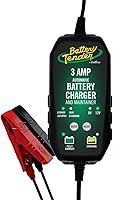
The Battery Tender 3 Amp supports 6 V or 12 V batteries and includes a ring-terminal and alligator-clip combo cable. Its automatic operation switches to float mode after charging.
The CTEK NXT 5 is a 12 V charger for several lead-acid types and LiFePO₄ batteries. It has automatic operation, selectable modes, and temperature compensation.
The Optimate 4 Quad Program is designed for compatible motorcycle batteries and offers separate programs for lead-acid and lithium batteries. Its programs also cover direct battery charging and certain compatible BMW or Triumph 12 V sockets.
Can a maintainer stay connected during storage?
A maintainer may stay connected during storage only when its instructions allow it and the setup is appropriate. Check the charger's guidance for continuous connection, battery type, temperature, and ventilation.
Place the charger and connections where they won't sit in water or be crushed by a vehicle door, hood, or storage cover. Keep the battery and charger away from heat, sparks, and open flames, and stop if you see damage, swelling, leakage, or unusual heat.
Use a grounded outlet and route the cord so it won't become a trip hazard or pull on the connection. Read are battery maintainers safe to leave connected for more precautions.
How do you connect a battery maintainer?
Connect the maintainer with the power off and in the order its manual specifies. Many chargers call for attaching the clamps or harness to the battery before plugging the charger into the outlet, but follow the model's directions.
Keep positive and negative connections clear, and make sure the clamps cannot touch each other or moving vehicle parts. If the battery is still installed, check the vehicle manual for the correct connection points.
After connecting, select the mode for the battery chemistry if the charger requires it. Our step-by-step guide to how to connect a battery maintainer covers the setup sequence.
What should you do if the maintainer won't charge?
If a maintainer won't charge, check the outlet, connections, selected mode, and battery condition first. A reversed connection, loose clamp, or battery voltage below the charger's detection limit can prevent charging.
Unplug the charger before adjusting connections. Then confirm that the selected mode matches the battery and that the battery terminals are clean enough to make contact.
If the charger still reports an error, consult its manual rather than repeatedly cycling power. A battery that is damaged, frozen, or deeply discharged may need a different recovery process or replacement.
How does a battery maintainer work for your vehicle?
For a stored vehicle, choose a maintainer that matches its battery and automatically manages charging during storage. Pick a model with the right voltage and chemistry support, then follow its connection and continuous-use instructions.
A general car or truck owner may prefer a 6 V and 12 V option with flexible connectors. A powersports owner should check the battery type and whether a compatible socket program is useful.
If you're unsure about the charging setup, start with how to use a trickle charger on a car or review the safety guidance before leaving any charger connected.
Frequently asked questions
How does a battery maintainer know when to stop charging?
A smart maintainer monitors battery voltage and uses its charging controls to reduce or pause charging once the battery reaches its target. Some models switch to a float or maintenance mode, then resume charging if voltage drops.
Follow the manual, since modes and behavior vary by charger.
Can a battery maintainer charge a dead battery?
Some maintainers can charge a low battery, but they may be slow and aren't all designed to recover a deeply discharged one. Check the charger's instructions for its minimum battery voltage and recovery modes.
A damaged battery may need professional assessment instead of repeated charging.
Is a battery maintainer the same as a trickle charger?
Not always. A basic trickle charger may supply a steady low current, while a smart maintainer can monitor voltage and change its output or enter a maintenance mode.
Product names aren't consistent, so check for automatic monitoring and the maker's instructions before leaving a charger connected.
Can I leave a battery maintainer connected all winter?
Many smart maintainers are designed for seasonal storage, but safe use depends on the specific charger, battery, location, and instructions. Match the charger to the battery chemistry, protect connections from moisture, and inspect the setup as directed.
See our guide to battery maintainer safety.